The targeting playbook
You can't out-write the wrong list.
What this is. Two things decide whether cold outbound works: who you send to, and what you say. Most teams spend all their time on the second one. This guide is about the first, because it comes first, and because getting it wrong caps everything the copy can do afterwards. We cover the four gates an audience has to pass, how to choose between audiences, who is reachable, when to strike, and what a clean list looks like.
THE MASTER VARIABLE
01Why the list comes first#
Take one email. Send it to two lists.
The first list is a thousand businesses scraped off a directory. The second is a thousand founders who match exactly who buys from you. Same words in both. The first returns bounces. The second books meetings.
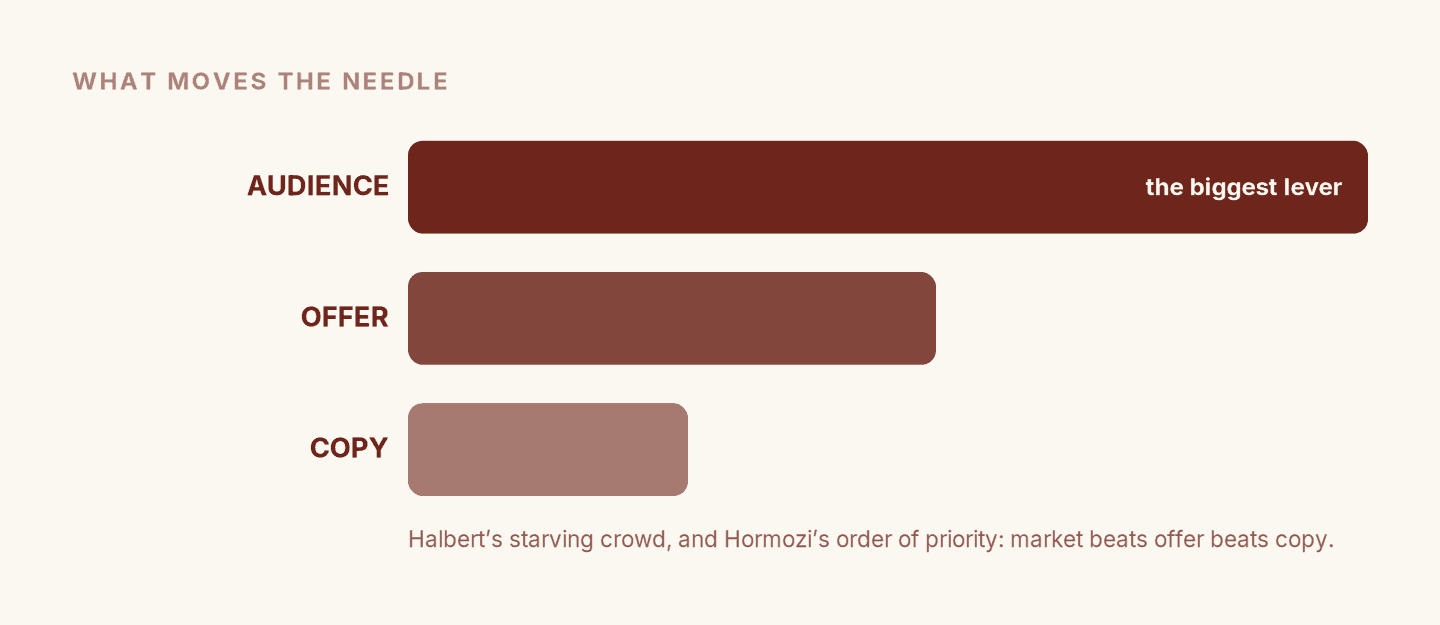
Gary Halbert taught this with a burger stand. He asked his students to imagine they were opening one, and told them they could pick a single advantage over the competition. What did they want?
People shout the best meat. A secret sauce. The lowest price. The best location.
Halbert says fine. Take all of them. I will take one advantage.
A starving crowd.
Your copy, your offer, your timing, your subject line: all of them are multipliers. The list is the number they multiply. A brilliant email to the wrong list is brilliant times zero, which is zero. A decent email to the right list converts, because the person reading it has the problem and can say yes.
This is why the list comes first, and why it caps everything downstream. It does not mean the words stop mattering. A great list with lazy copy underperforms too, which is what the copy guides in this series are for. It means the ceiling gets set here, before anybody writes a word.
Most outbound dies at this input. The team never finds out, because they are busy testing the multiplier on a list that was always going to return nothing.
A bad list is worse than nothing, because it charges you.
Every send to a dead address teaches your domain that you email dead addresses. Bounces climb. Complaints climb. The sending reputation you spent months building gets spent on garbage. So the bad list is a negative, and it damages the channel you wanted for the good list later.
Four questions decide your outcome. Who is this for. Can I reach them. When is the moment. Is my data clean.
02The four gates#
An audience has to pass four gates. Fail one and you drop it, however good the other three look.
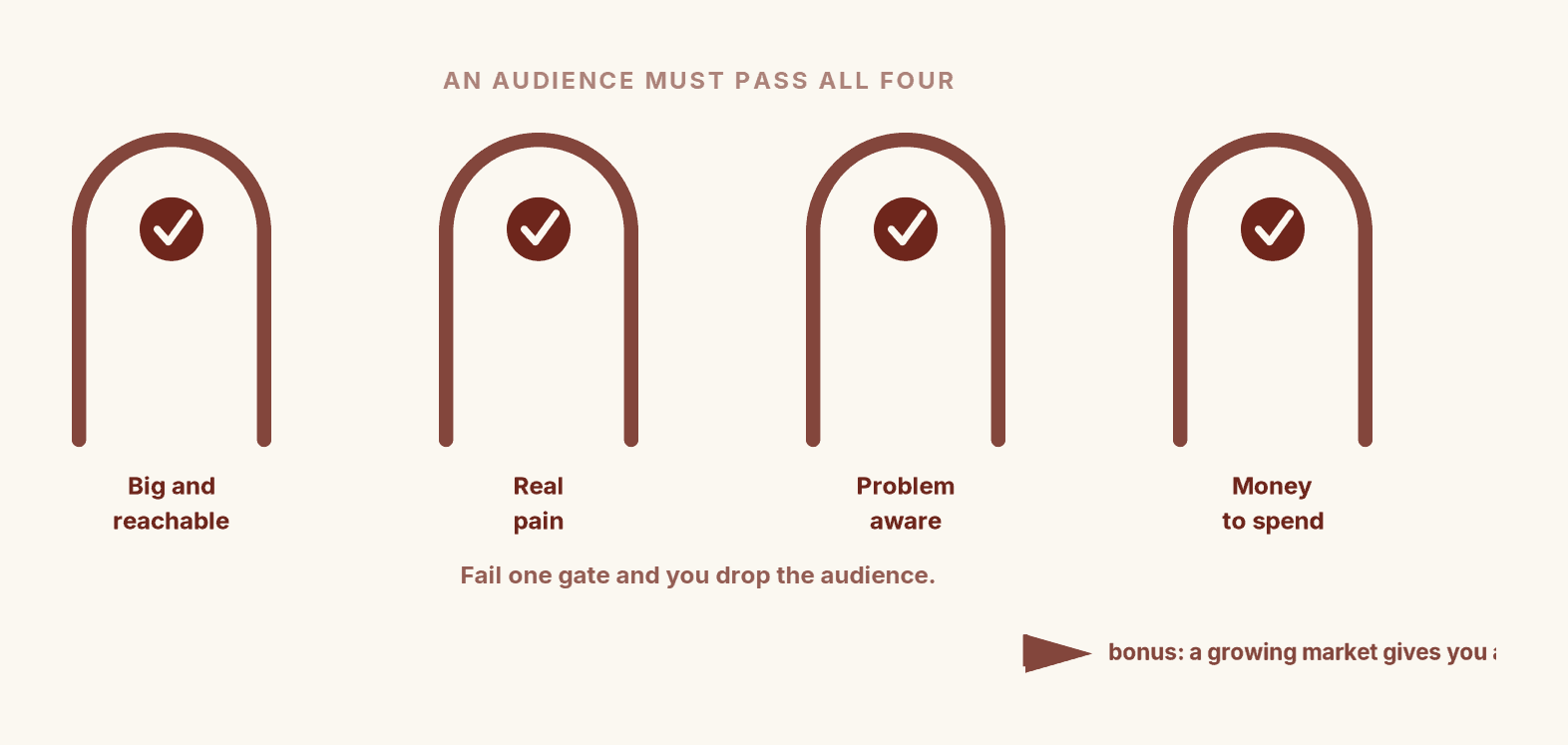
The first gate is that you can reach them. There have to be enough of them to fill a pipeline, and you have to be able to build the list. A perfect audience you cannot find is useless to you. Reachable means it literally: they are gathered somewhere you can get at. A list, a group, an association, a channel.
The second gate is that they have the problem. Real pain, happening now, and not something you have to talk them into. The pain is the pitch. The sharper it is, the easier everything after it becomes.
The third gate is that they know they have it. This one gets skipped constantly and skipping it is expensive. Teaching a cold market about a problem it has not noticed almost never works. You want people who are already looking for a fix.
The fourth gate is that they can pay. The fix has to be worth money and they have to have it. Pain with no budget is charity.
One more thing sits on top as a bonus. If the market is growing, you get a tailwind. When two audiences both pass, take the one with the wind behind it.
Turning the gates into a filter
Everybody has an ideal customer profile. Most of them are wishlists. "Mid-market to enterprise companies in North America who value quality" is not an ICP, it is a daydream with firmographics attached.
Here is the fast way to find the real one. Stop guessing and look backward.
Pull your last twenty closed customers, especially the ones who closed fast, stayed, and sent referrals. Find what they had in common before they bought. Same size? Same trigger? Same job title on the contract?
Then flip it. Pull the ones who churned, ghosted, or haggled for months, and find what they shared too. That second list is your exclusion filter, the people to keep off the list however good they look on paper.
The output is not a paragraph. It is something a list builder can run:
EXAMPLE ICP SPEC (turn yours into something a list can run)

Company size:     11 to 50 employees
Industry:         B2B software, IT services, digital agencies
Geography:        US and Canada
Title:            Founder, CEO, Co-founder, VP Sales
Must-have signal: hiring a sales role in the last 30 days
                  OR raised a round in the last 6 months
Exclude:          teams under 5 people, and anyone we lost
to "no budget" in the last 12 months03Choosing between audiences#
Run a few audiences through the gates and more than one will pass. Good problem. Now choose.
First, a word about words. Say audiences, and be careful with "industries." Industry is only one way to slice a group of companies. Sometimes what your best buyers share is a size band, or a tool they run, or a job title. Keep the word broad so your thinking stays broad.
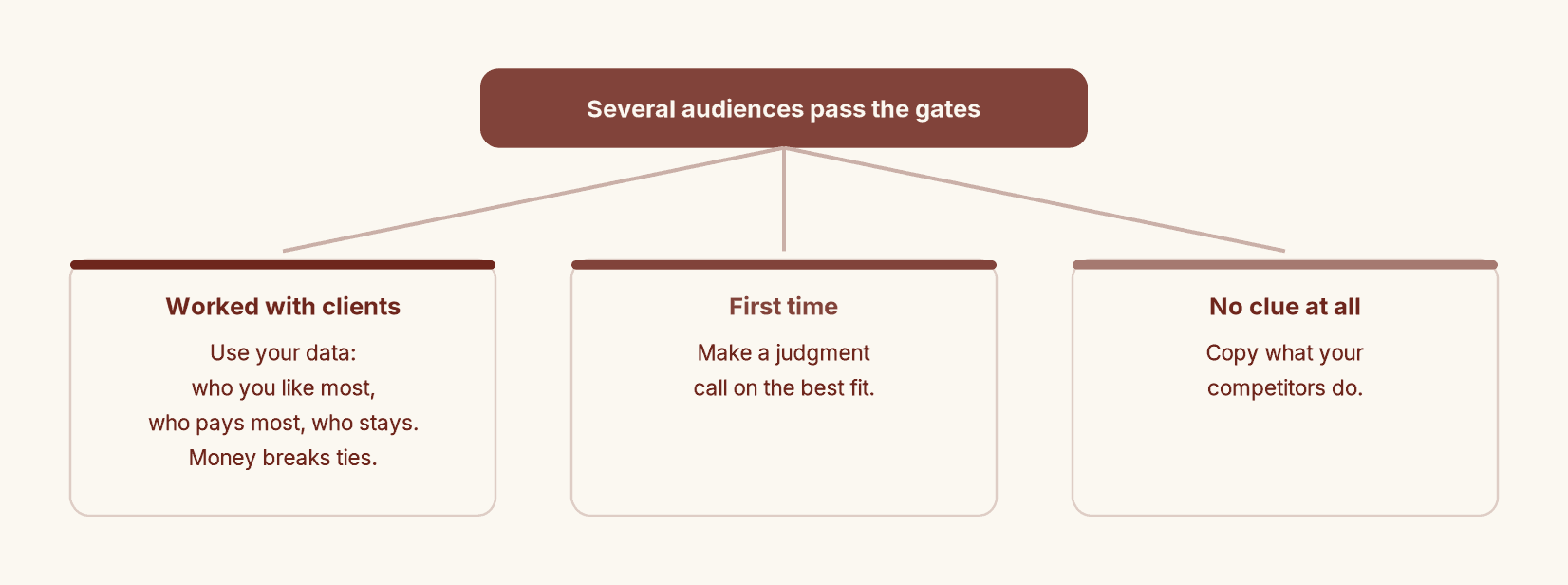
If you have clients already, use the data. Look at three things: who you enjoy working with, who pays you most, and who stays longest. Usually all three point the same way, because good-fit clients tend to be profitable and pleasant at once. When they disagree, money decides.
If you do not have clients yet, make a call. Pick where the best fit and the best money probably sit, then commit long enough to learn something.
If you have no idea at all, look outward. See who your competitors sell to. When several serious players are fishing the same pond, there is usually a reason.
THE THREE DIALS
04Seniority#
Should you email the top or the middle?
Go high and people tell you the executive is too busy. Go middle and people tell you the manager cannot buy. Both warnings are half true, and the data sorts them out.
Sales.co studied a million cold emails to settle it.
Here is the surprise. Executives and directors reply at about the same rate. Nearly identical.
But the replies are made of different stuff.
A director's reply is usually noise. Out of office. "Not for us." Passed to someone else.
An executive replies when they mean it, and they do it three times as often as a director does. Same number of replies, three times the value.
So when do you go middle? When a practitioner has to champion you internally before the buyer will look at anything. That person forwards you up, which is the whole point of them.
When you go high, match the register. A founder gives you seconds, so the email is short, leads with the outcome, and asks for almost nothing.
Subject: pipeline for the two new AEs

Hi Sarah - saw Northwind is hiring two account execs. New reps
with no pipeline waiting is the fastest way to burn a ramp, so
the timing felt right. We build outbound that books qualified
meetings. Mind if I send over a couple of examples from teams
like yours?
That last line is deliberate. In the same study, "mind if I send more info?" beat "book a 30-minute demo" by about five times. You just earned a busy founder's attention, so do not immediately demand thirty minutes of it.
There is a catch, and the next section is built on it. Going high only works when high is reachable. The CEO of a fifteen-person company reads their own email. The CEO of a fifteen-thousand-person company does not.
05Company size, and the wall#
Seniority is the dial people argue about. Company size is the one they ignore, and it matters more.
The same study counted positive replies from executives by company size.
| Company size | Positive replies |
|---|---|
| 1 to 10 employees | 532 |
| 11 to 50 | 317 |
| 51 to 200 | 112 |
| 201 to 500 | 26 |
| Over 10,000 | 3 |
Read that the right way round. It does not say big companies are the prize. It says a cold email cannot reach an executive at a big company.
Three replies from the enterprise band is a wall. Five hundred and thirty-two from tiny companies is an open door.
Why is the door open? Three reasons, and they are all about the same person.
There is no gatekeeper, because the founder reads their own inbox. They can decide, because there is no procurement and no committee, so they say yes on the call. And they still care, because the CEO of a fifteen-person company is in the weeds and your tool touches their day. A big-company executive delegated that away years ago.
One caveat so you use this correctly. Those are raw counts, and more small companies were on the list to begin with, so do not treat it as an exact multiplier. What survives is the gap between seniorities and the pile-up of replies under fifty employees.
The wall is a fork rather than a dead end.
If you sell to small founder-led companies, good. Cold email works, and this library is your toolkit. If you need big companies, the wall is telling you something useful: change the tool. You cannot volume your way past an executive assistant. The enterprise access and incentive guides cover what does get through.
06Industry, and the trade-off#
Size tells you who is reachable. Industry tells you who is receptive.
The same data ranked industries by executive replies. Software led, then internet, IT services, financial services and biotech.
The pattern matters more than the ranking. The industries that answer decide fast, are chasing growth, already live in email, and will try something that might work. Financial services and biotech are the interesting ones, because they are not impulsive at all, but they move hard when the pain is real. Urgency beats culture.
So industry is a starting filter. Here is the trap.
Industry is a filter and never a target. You are not emailing "SaaS companies." You are emailing one company showing signs of your problem today.
Two identical software companies can be opposite targets. One just raised and is hiring five salespeople with no pipeline. The other is flat and happy. Same industry, same size, nothing alike.
Firmographics build the pool. Behavior picks who to email out of it.
Every dial costs you something
There is no free lunch here. Almost every choice trades reply rate against deal size.
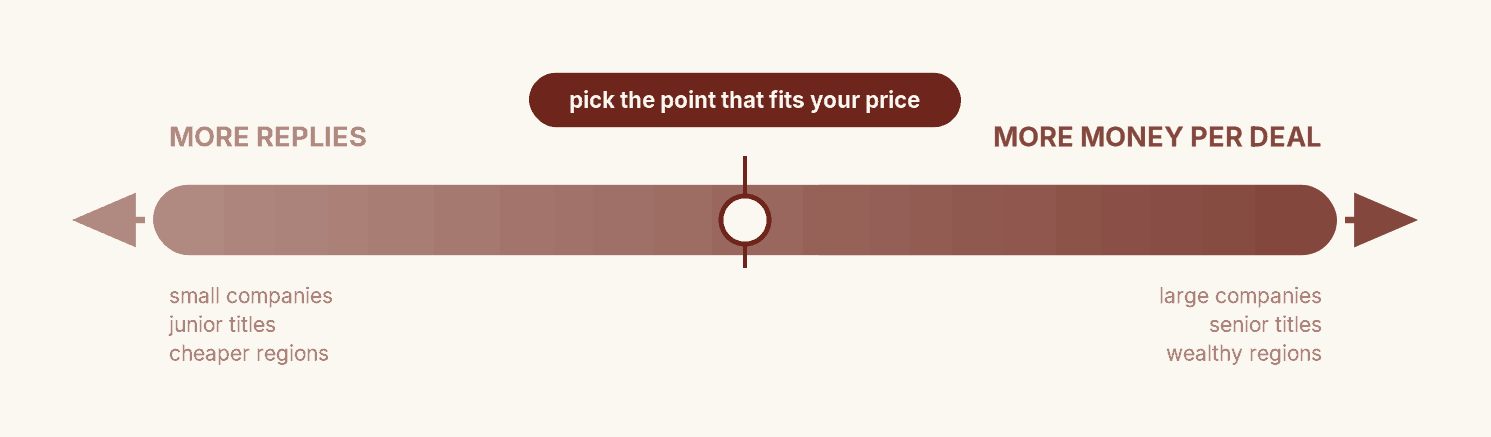
Bigger companies reply less and pay more. Smaller ones reply more and pay less. Junior titles reply more and cannot sign. Senior titles reply less and can. Some regions answer often and spend little, others answer rarely and spend a lot.
You cannot dodge the trade-off, only pick your spot on the line.
A cheap offer needs volume, so it lives to the left. A premium offer needs fewer, richer conversations, so it lives to the right. Find your price on that line and target the people who sit there.
TIMING
07Signals#
Everything so far has been about who. This is about when.
The same person is a different prospect depending on the week you catch them. Indifferent in a quiet month, urgent the week after something breaks.
A signal is any public event saying the problem is live right now. Five of them are worth watching.
Funding, because a raise means budget, a mandate to grow, and pressure to show results fast.
Sales hiring, because a company posting sales roles is telling you it needs pipeline. Hiring in the function you serve is the sharpest signal there is.
A new executive, because they have ninety days to make a mark and buying is how they show they are changing things.
New technology, whether it sits next to yours, plugs into yours, or is the thing you replace.
Expansion into a new market, product or office, which creates fresh problems and fresh budget, all of it public if you are watching.
Signals work because the timing supplies the warmth. There is no relationship yet and there does not need to be one.
Reachdesk found that outreach triggered on a real buying signal converted to a sales-accepted opportunity 65 percent of the time. Without the signal it was 50 percent.
Signals stack on top of the dials rather than replacing them. A founder-led software company that just raised and is hiring SDRs is barely a cold prospect at all. They are a warm prospect who has not heard of you, which is the easiest thing in outbound to convert.
THE INPUT
08What a clean list looks like#
A perfect ICP on dirty data is still a dead campaign. The emails bounce, the personalisation is wrong, and the domain burns. This is the least glamorous work in outbound and the highest leverage.
A list that works has five properties, and missing one drags the whole thing down.
It is verified, so every address is checked before you send. Bounces kill domains faster than anything else.
It is enriched, so every contact carries what you need to target and personalise: role, size, industry, stack, signals. A list of names and emails is a list you can only spray.
It is deduplicated, so nobody gets hit twice and no company gets blanketed with the same message to five people. Duplication looks careless to a human and looks like spam to a filter.
It is ICP-matched, so every row passes the gates. The discipline here is subtraction, because a small list of exact fits beats a big list of almost-fits.
And it is signal-layered, so the list knows what is happening at each company now and you can send by readiness instead of blasting flat.
Build, buy, or enrich
Buying is fastest and weakest, because the data is often stale, sold to everyone, and unverified.
Building against your own criteria is slower and much stronger, because you control fit and freshness.
Enriching multiplies both. You layer verified emails, firmographics and live signals onto a thin list until it is worth sending to.
Clean it forever, not once
Data rots. People change jobs, companies get bought, addresses die. A list that was clean six months ago is dirty today, and sending to it as though it were still clean is how good programs fall apart.
You will not notice at first. Then bounces creep up, placement drops, and you stop trusting your own numbers.
09Match the tool to the target#
Put the dials and the signals together and the picture is simple. Different prospects need different approaches, because the tool has to match the difficulty.
Reachable people get cold email. Small, founder-led, receptive industry, live signal, reads their own inbox. The door is open and you have to knock well. A good list plus sharp copy plus timing is the whole recipe.
Walled people need something else. Big companies, senior people behind gatekeepers, slow industries. More cold email here is throwing volume at a wall.
What works instead is giving first. A real incentive that earns attention a subject line never will, or a piece of genuine work that proves you are good before you ask for anything.
HockeyStack looked at 390 million B2B emails. Outbound with a gift produced roughly triple the meeting rate and nearly double the win rate.
Attention is only half of it. The enterprise buyer you finally reach is the most sceptical person you will pitch. A gift opens the door, but it does not remove the fear of betting budget on you. That is what a real guarantee is for, and the offer guide covers how to build one.
Top accounts get both. The gift opens the door and the work walks through it. Treat that as a top-accounts move rather than a default.
10Start wide, then narrow#
Launch with your filters wide, and there is a reason for it.
Right now everything you believe about your perfect audience is a guess. The campaign is the thing that turns the guess into evidence. So cast wide first to gather signal, and resist narrowing before the data has earned it.
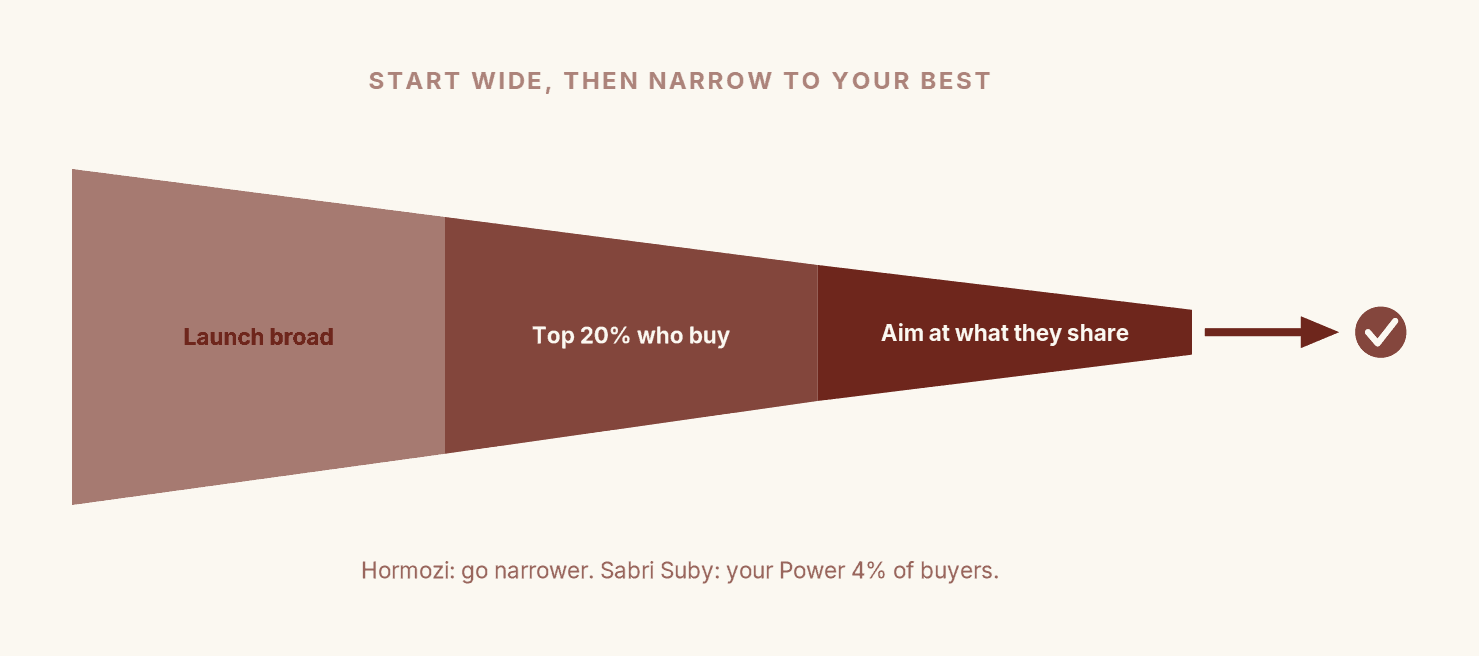
Once campaigns are running, look at the top twenty percent of the people who bought. Not the ones who replied. The ones who bought.
Find what they share. A sub-industry, a size band, a tool in their stack, a job title. Whatever it is becomes your next filter.
The twenty percent becomes your new hundred percent. Do it again and you land on something smaller still, the few percent who drive most of the revenue.
So the motion is: go wide, watch who buys, tighten, repeat. Targeting is a loop rather than a decision you make once, and you pull it tighter every cycle.
11The scorecard#
Run these nine questions against a list before you spend a single send on it.
| # | Question | A strong answer |
|---|---|---|
| 1 | Gates | Does the audience pass all four: reachable, has the problem, knows it, can pay? |
| 2 | Backward-tested | Does this list look like the customers who closed fast and stayed? Does it exclude the ones who churned? |
| 3 | Seniority | Can the title we are emailing decide for a deal this size, or champion it internally? |
| 4 | Reachability | At these company sizes, is the person reachable by email, or behind a wall? |
| 5 | Industry | Are we weighted toward receptive industries, and resourced for the hard ones? |
| 6 | Signal | Does the list know what is happening at each company now? Is it sequenced by readiness? |
| 7 | Data quality | Verified, enriched, deduplicated, and cleaned recently? |
| 8 | Tool match | Does the tool match how reachable each segment is? |
| 9 | Trade-off | Did we pick our spot on the reply-rate versus deal-size line on purpose? |
Any weak answer is a leak, and a leak in targeting costs more than a leak anywhere else, because everything downstream multiplies it.
The mistakes that kill campaigns
Spray and pray. A big unfiltered list blasted on a schedule. It feels like volume and it produces bounces and a burned domain.
The wishlist ICP. Targeting who you wish bought from you. The backward look in Section 02 exists to kill this, and it is the most common error there is.
Ignoring the wall. Emailing enterprise executives as though a good subject line will get past their assistant. It will not.
No behavior layer. A well-targeted list with no idea what any of these companies are doing this month.
Dirty data. Skipping verification, then wondering why bounces are high.
The wrong title for the ask. Emailing a practitioner about a decision they cannot make, or an executive about a detail they delegated away years ago.
Buy once and rot. Treating a bought list as permanent while it decays underneath you.
Narrowing too early. Picking the perfect niche on day one, before a campaign has told you anything. That is a guess in a lab coat.
Everyone wants the secret subject line. There is not one. Teams win at outbound because they email the right people, at the right moment, with clean data, using the tool that matches how reachable those people are. That is the boring work most teams skip because it is harder than tweaking copy. Do the work on the list and average copy books meetings. Skip it and the best copy in the world lands where nobody looks. Who you email decides more than what you write. Start there.
This guide is one of a series. If you would rather have your ICP mapped, your list built and verified, and the right tool pointed at each segment for you, that is the conversation this was meant to start. Book a working session at close3x.com/demo or revenue.inc/demo, and we will show you where the leaks are.